
Best Ways to Move Delegates for Singapore Events
12 September 2026
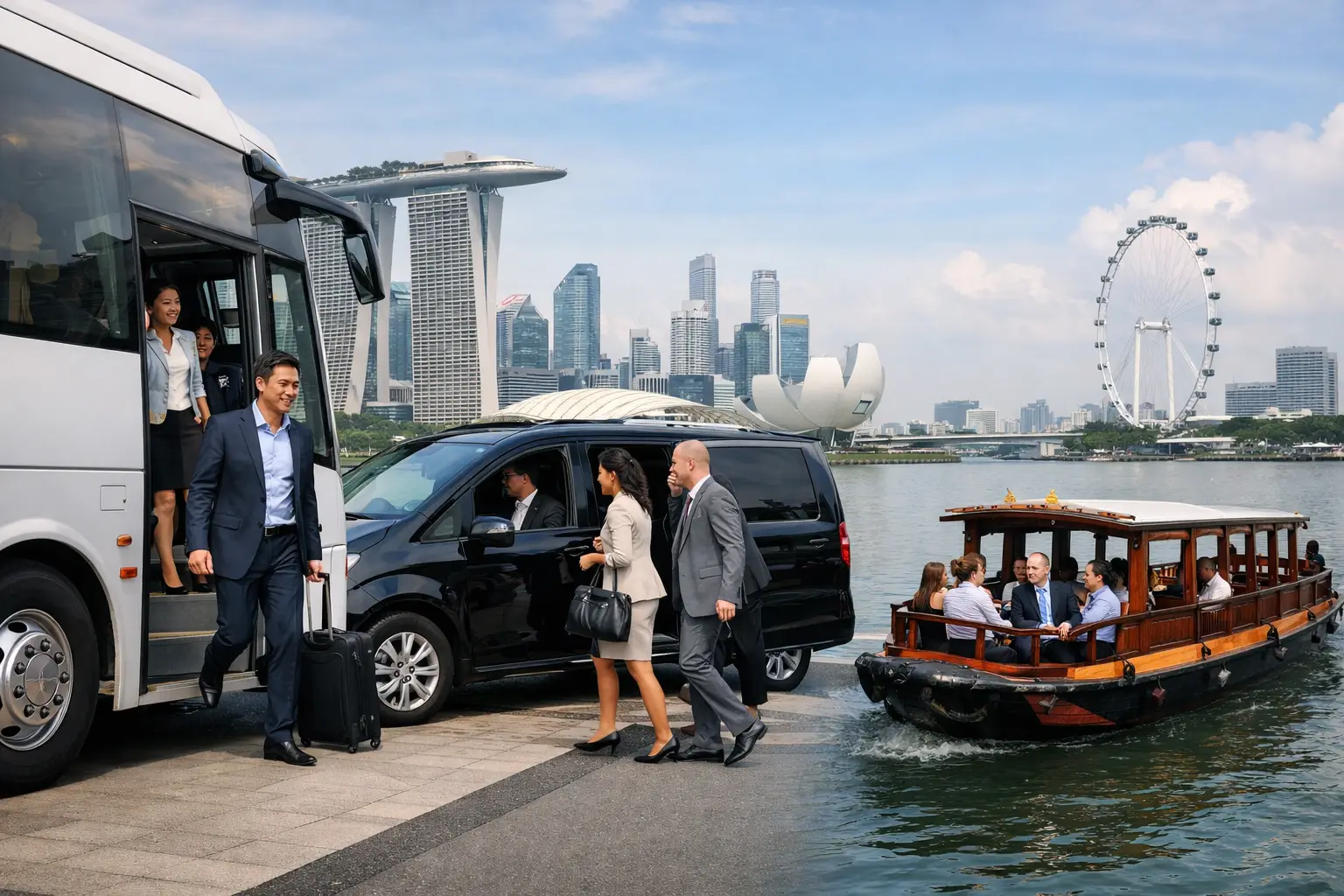
A delegation can arrive on the same flight, stay at the same hotel, and attend the same conference, yet still experience a poorly managed event if its ground transportation is fragmented. Long waits at the curb, unclear pickup instructions, vehicles that do not match group size, and missed program segments quickly affect the perception of the host organization. The best ways to move delegates begin with treating transport as an operational workstream, not a last-minute booking task.
For Singapore conferences, board meetings, incentives, and official visits, the right approach depends on delegate count, hotel locations, luggage volume, protocol requirements, and how tightly the program is scheduled. A single executive transfer requires a different plan from a 300-person convention shuttle program. The common requirement is control: clear movement plans, appropriate vehicles, accountable dispatch, and a reliable point of contact when plans change.
Start With the Delegate Journey, Not the Vehicle
Transport planning should begin by mapping every movement a delegate must make. This includes airport arrivals and departures, hotel transfers, venue shuttles, dinners, off-site activities, and any VIP movements that need separate handling. Once these journeys are visible, vehicles can be assigned with purpose instead of being selected simply because they are available.
An arrival manifest is particularly valuable. It should record flight number, scheduled arrival time, terminal, passenger count, luggage estimate, hotel, contact number, and any service notes. For international groups, include the expected time needed for immigration and baggage collection. A flight landing at 8:00 a.m. is not necessarily ready for curbside pickup at 8:10 a.m.
For executive travelers, individual meet-and-greet transfers in an executive sedan, luxury sedan, or premium MPV provide the most discreet experience. For a group arriving within a narrow time window, minibuses or coaches may be more efficient. The decision is not only about seats. It is about baggage capacity, transfer timing, passenger comfort, and the level of service expected by the delegation.
Separate VIP Travel From General Delegate Transport
One of the most effective ways to protect an event schedule is to run VIP travel separately from the main delegate movement. Senior executives, speakers, government representatives, and clients may require flexible timing, private arrival areas, security coordination, or direct transfers between meetings. Putting them on a general shuttle schedule can create unnecessary exposure if the agenda changes.
A dedicated chauffeur-driven sedan or premium MPV allows the VIP itinerary to remain responsive. Chauffeurs should receive the correct passenger name, pickup point, destination, flight details where relevant, and protocol notes before the assignment begins. The vehicle should arrive early and remain under dispatcher oversight throughout the movement.
General delegates, meanwhile, benefit from a clearly scheduled shuttle or coach operation. This separation gives organizers control without overspending on private cars for every attendee. It also prevents the late arrival of one passenger from delaying a full vehicle of delegates.
Build Airport Transfers Around Arrival Waves
Airport transport is where a delegate program first proves whether it is organized. Rather than dispatching vehicles based only on scheduled flight times, group arrivals into practical waves. Flights landing within a similar period may share a coordinated bus departure, while travelers with early, late, or premium requirements receive individual transfers.
There is a trade-off between minimizing vehicle cost and minimizing delegate waiting time. A full coach may offer better cost efficiency, but asking travelers to wait 45 minutes after a long-haul flight can weaken the arrival experience. For high-value groups, a shorter maximum wait time is usually the better operating standard.
Use flight tracking rather than relying only on the original flight schedule. Delays, early arrivals, gate changes, and missed connections affect the dispatch plan. A transport provider with active dispatcher review can adjust chauffeur timing before a guest is left waiting at the terminal.
Pickup instructions must be precise and distributed before travel. Delegates should know who will meet them, where to go after customs, what vehicle identifier to look for, and whom to call if they cannot locate the representative. Vague instructions such as "meet your driver outside" create avoidable calls at the busiest point of the journey.
Match Fleet Type to the Actual Movement
Vehicle planning is often weakened by focusing only on passenger capacity. A vehicle that technically seats seven may not suit seven international travelers with full-size luggage. Similarly, a large coach may be impractical for a hotel driveway, restricted loading zone, or small off-site venue.
For one to three executives, sedans offer the strongest combination of presentation, privacy, and direct routing. Premium MPVs are suitable when a small party needs more luggage room or prefers to travel together. Minibuses work well for departmental groups, speaker teams, or airport waves with moderate baggage. Mini coaches and full-size coaches are generally best for structured hotel-to-venue shuttles, city tours, dinners, and high-volume conference transport.
The best ways to move delegates also account for vehicle rotation. If a conference session ends at 5:00 p.m. and a dinner begins at 6:00 p.m., one coach may not be able to complete multiple hotel loops in time. Review loading time, road conditions, venue access, and passenger boarding behavior before committing to a rotation schedule. A plan that works on paper can fail when 80 people leave a ballroom at once.
Use Fixed Shuttle Windows for Large Programs
For a large delegate group, fixed shuttle windows create order. Publish departure times, pickup points, and estimated travel times in the event app, delegate pack, signage, and daily program. Keep the message consistent across every channel.
A typical operating pattern may include a morning hotel-to-venue service, a limited mid-morning top-up shuttle for late arrivals, an evening return service, and dedicated transport for optional dinners or tours. Where hotels are close together, a shared route may be sensible. Where locations are spread across Singapore, separate routes can reduce ride times and protect punctuality.
Do not assume every delegate will follow the same schedule. Speakers, exhibitors, organizers, and sponsors frequently have earlier calls or later departures. Build a small contingency allocation for these movements rather than disrupting the main shuttle plan. This may be a standby MPV, a dedicated minibus, or a limited number of pre-approved point-to-point transfers.
Control the Curbside Experience
The most polished fleet can still look disorganized without on-site coordination. At busy hotels, convention centers, and dining venues, the curbside area is a live operational environment. Vehicles may face access restrictions, loading limits, security procedures, or competition with other events.
An on-site transport coordinator should manage vehicle staging, communicate with the venue, direct delegates, and relay changes to dispatch. For higher-volume movements, use visible but professional signage and numbered boarding zones. Delegates should not need to guess which coach is going to their hotel.
Timing matters at both ends of the route. Vehicles should be staged early enough to load calmly, but not so early that they block the driveway or incur unnecessary waiting charges. The coordinator should also confirm that the final passenger count aligns with the manifest before releasing the vehicle, especially for airport departures.
Plan for Exceptions Before They Become Problems
Delegate transportation rarely runs exactly as scheduled. A flight is delayed, a meeting overruns, heavy rain slows loading, or a VIP adds an unscheduled stop. The appropriate response depends on the importance of the movement and the available fleet, which is why contingency should be included from the start.
For complex programs, establish an escalation process. Decide who can approve an additional vehicle, a route extension, an overtime request, or a last-minute VIP transfer. Provide that person with direct access to the transport coordinator or dispatcher. Waiting for approval through multiple event contacts can turn a small adjustment into a missed departure.
Commercially insured, licensed vehicles and trained chauffeurs are foundational, but they are not the entire solution. Reliable delegate mobility also requires updated manifests, live communication, routing discipline, and decision-makers who understand the program priorities.
Choose a Provider That Can Scale With the Program
A delegate movement plan may combine online-booked executive transfers with a manually scoped transport operation for shuttles, coaches, and event staffing. That mix is often the most practical approach. Fixed-rate bookings can handle straightforward airport or city transfers, while larger programs need a quotation based on routes, timing, fleet mix, and on-site requirements.
Ask transport partners operational questions: Who reviews dispatch? How are flight changes monitored? Is there a single coordinator for the event? How is vehicle allocation handled if a coach is delayed? Can the provider support both senior executive travel and mass delegate movements? Limo Z approaches these requirements through fleet coordination, senior dispatch review, and transport planning that can scale from a private VIP transfer to a multi-vehicle event program.
The strongest delegate transport plan is the one guests barely have to think about. When the right vehicle is waiting, instructions are clear, and every transfer supports the event schedule, delegates are free to focus on the reason they traveled to Singapore in the first place.