
Delegation Transport Examples for Singapore Events
2 September 2026
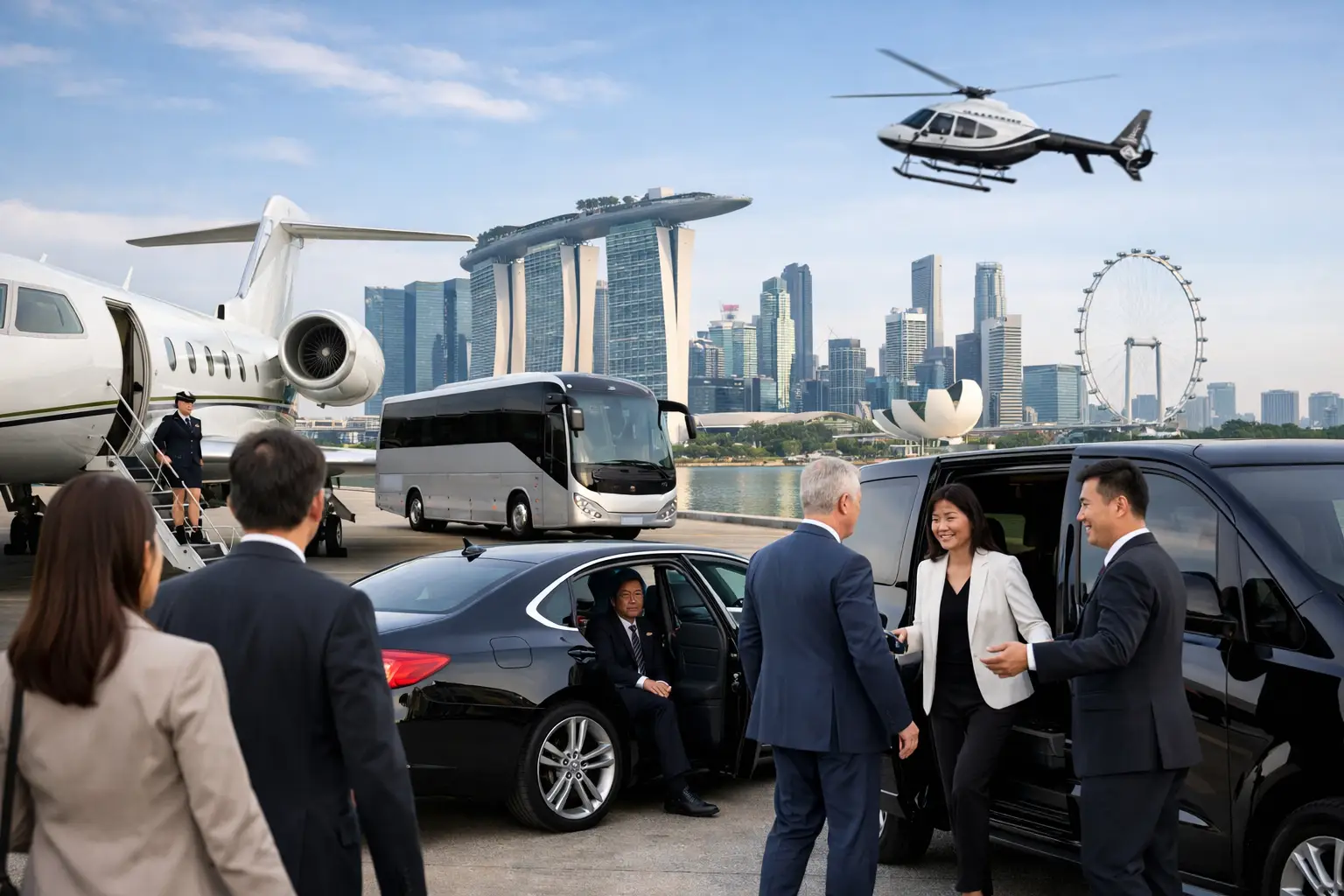
A delegation does not move like a standard group booking. One delayed airport arrival can affect a ministerial meeting, a factory visit, a hotel check-in, and the departure of an entire escort team. These delegation transport examples show how Singapore programs are planned when punctuality, protocol, and clear operational control matter as much as vehicle quality.
For corporate hosts, MICE organizers, government liaison teams, and executive assistants, the central question is rarely just, “What vehicle do we need?” It is how to move the right people, on the right schedule, through different locations without exposing the program to avoidable delays. The answer depends on delegation size, baggage volume, security expectations, venue access, and whether the itinerary can tolerate changes.
What Delegation Transport Requires Beyond a Vehicle
A delegation may include senior executives, overseas government representatives, investors, technical specialists, media, interpreters, and support staff. Their transport needs are rarely identical. A principal may require a luxury sedan and a discreet chauffeur, while the wider party needs a minibus or coach with a designated coordinator.
This is why a single large vehicle is not automatically the best solution. A coach can be efficient for a fixed conference transfer, but separate vehicles provide better control when arrival times, hotel locations, or access credentials differ. The planning task is to create a movement plan that reflects the actual hierarchy and timing of the program.
In Singapore, routes can be short in distance but sensitive in timing. Peak-hour traffic, road restrictions near major venues, airport congestion, loading bay rules, and security screening all influence the schedule. Professional planning allows for early vehicle positioning, a realistic boarding window, and a recovery option if an itinerary runs behind.
Delegation Transport Examples by Program Type
1. Executive airport arrivals with staggered flights
A regional leadership team is arriving at Singapore Changi Airport from several cities. The CEO lands in the morning, three board members arrive at midday, and the wider management team reaches Singapore that evening. They are staying at the same hotel but need different vehicle standards and baggage capacity.
The principal arrival can be assigned a luxury sedan or premium MPV, depending on the number of travelers and luggage. Each subsequent executive arrival receives an individually tracked transfer, with dispatch monitoring flight changes and chauffeurs positioned ahead of the pickup window. A larger MPV may suit pairs of executives traveling together, while a minibus can handle the management group arriving on the same flight.
This approach avoids holding senior guests at the airport while waiting for others. It also protects the hotel arrival experience: the delegation is received in an orderly sequence rather than arriving as an unmanaged crowd at the driveway.
2. Conference delegation from hotel to convention venue
Consider a 45-person overseas delegation attending a two-day conference at a Singapore convention center. The group includes speakers who must arrive early, attendees who follow the main schedule, and event staff carrying presentation materials.
The speakers can travel in executive sedans or premium MPVs on an earlier call time. A mini coach or full-size coach then handles the main guest movement from hotel to venue. A separate van or MPV can be assigned to staff and materials, particularly where setup deadlines do not match guest boarding times.
The operational value is in the departure sequence. Rather than telling everyone to meet in the lobby at one vague time, the transport coordinator sets a vehicle call, boarding period, and departure cut-off. The dispatch team confirms vehicle positions and can communicate exceptions quickly if a passenger is delayed. For return transfers, the same vehicles can be staged according to session end times, not merely the official conference closing time.
3. Investor roadshow across multiple business locations
An investor delegation may have breakfast in Marina Bay, a corporate presentation in the central business district, a site visit in Jurong, and an evening reception at Sentosa. This is not a coach-only itinerary, even if the delegation is large.
Senior investors and company leadership may need two executive sedans or luxury MPVs so confidential conversations can continue between appointments. Analysts, assistants, and support personnel can travel in a minibus. Where the roadshow includes product equipment, documents, or event materials, a separate logistics vehicle may be appropriate rather than filling passenger cabins with cases.
A routed itinerary should include realistic dwell times at every stop. Building access, elevator transit, visitor registration, and group photography can all add minutes that do not appear on a calendar. A disciplined transport plan also identifies the next approved pickup point before the group enters each site, reducing confusion when the visit ends.
4. Government or diplomatic protocol movement
Protocol-led transport demands a higher level of discretion and role clarity. A visiting delegation may include a principal, official aides, security personnel, advance staff, and interpreters. Vehicles must be selected not only for capacity but for the expected presentation and order of movement.
A typical arrangement might place the principal in a luxury sedan or premium MPV, followed by support vehicles for aides and staff. If a larger contingent is attending the same engagement, a minibus or coach can operate separately under a fixed manifest. Chauffeurs should receive confirmed pickup names, venue instructions, timing requirements, and escalation contacts before deployment.
The trade-off is that protocol programs can be less flexible than commercial meetings. An unplanned stop, a last-minute vehicle change, or an unfamiliar chauffeur at the pickup point may create unnecessary friction. Early confirmation of vehicle assignments, route expectations, and credentials is therefore more valuable than trying to optimize every movement at the last minute.
5. Site visits for overseas clients or technical teams
Manufacturing, construction, energy, technology, and healthcare delegations often visit locations outside the usual hotel-to-office corridor. These trips may involve industrial estates, business parks, campuses, or controlled facilities where coach access, parking, and security clearance vary.
For a technical group of 12 to 18 people, a minibus can offer the right balance of capacity and access. A full-size coach may be more cost-efficient for 30 or more attendees, but only if the site can receive it and the group will remain together. Senior hosts or clients may travel separately in an executive vehicle when the visit includes a private briefing before the main group arrives.
The transport brief should state the exact gate, the onsite contact, the required arrival time, and whether passengers need identification or personal protective equipment. A driver who knows only the street address may still face a delay at a large industrial complex. Good delegation planning accounts for the final 500 meters, not just the route to the property.
6. Large-scale summit or incentive program
For a summit with multiple hotels, gala venues, airport arrival banks, and optional tours, delegation transport becomes a managed mobility program. The challenge is not simply fleet size. It is coordinating arrivals, departures, manifests, venue loading zones, hospitality teams, and changing participant counts across several days.
A practical fleet mix may include sedans for VIPs and speakers, premium MPVs for executive pairs and airport families, minibuses for smaller hotel clusters, and coaches for main venue transfers. A transport desk or appointed movement coordinator can manage no-shows, late flight arrivals, ad hoc transfers, and vehicle redeployment.
At this scale, manual quotation and detailed dispatch planning are usually preferable to a standard online booking. The itinerary needs an operational review before vehicles are assigned. Limo Z approaches these programs with fleet coordination, senior dispatch oversight, and clear movement schedules rather than treating a large delegation as a collection of unrelated rides.
Building a Delegation Transport Brief
A precise brief produces a more reliable quotation and a better operating plan. It should identify the number of travelers, passenger categories, flight details, hotel names, venue addresses, daily schedules, luggage assumptions, and primary onsite contacts. If VIPs require separate vehicles, state that early. If the group is likely to split after a dinner or site visit, include that possibility before final fleet allocation.
It also helps to identify what cannot move. A keynote speaker, a principal guest, or a delegation leader may have a non-negotiable arrival time. Those movements should be planned first, with the broader group schedule built around them. By contrast, an optional city transfer or hospitality activity may be assigned a wider time window and more flexible vehicle use.
For airport programs, share flight numbers instead of relying only on scheduled arrival times. For venues, provide the preferred loading bay or drop-off point, not just the venue name. For multi-day programs, confirm whether the same chauffeur and vehicle assignment is preferred for key executives. Continuity can be worthwhile when discretion and familiarity are priorities, though it may reduce flexibility during a major schedule change.
Choosing the Right Fleet Mix
Vehicle selection should follow passenger roles and route conditions. Executive sedans work well for one to three travelers with light luggage and a premium arrival standard. Luxury sedans are appropriate for principal guests who require a more formal VIP transfer. Premium MPVs provide useful flexibility for small executive parties, airport luggage, and family members traveling with a principal.
Minibuses are suited to smaller teams, staff movements, and technical site visits where a coach may be impractical. Mini coaches and full-size coaches are effective for fixed group routes, conference shuttles, and hotel-to-venue transfers. Their value increases when boarding times, passenger counts, and drop-off locations are tightly controlled.
The most efficient choice is not always the fewest vehicles. Adding one support vehicle can protect an executive schedule, separate luggage from passengers, or give event staff the ability to arrive early. For high-stakes programs, that margin is often worth more than the apparent savings from running every traveler on one vehicle.
A well-run delegation transfer should feel quiet to the passengers because the planning has already done its work. Start with the people whose timing cannot fail, build the group movements around them, and give the dispatch team enough detail to act before a minor change becomes a visible problem.