
VIP Airport Arrival Service Singapore Explained
26 July 2026
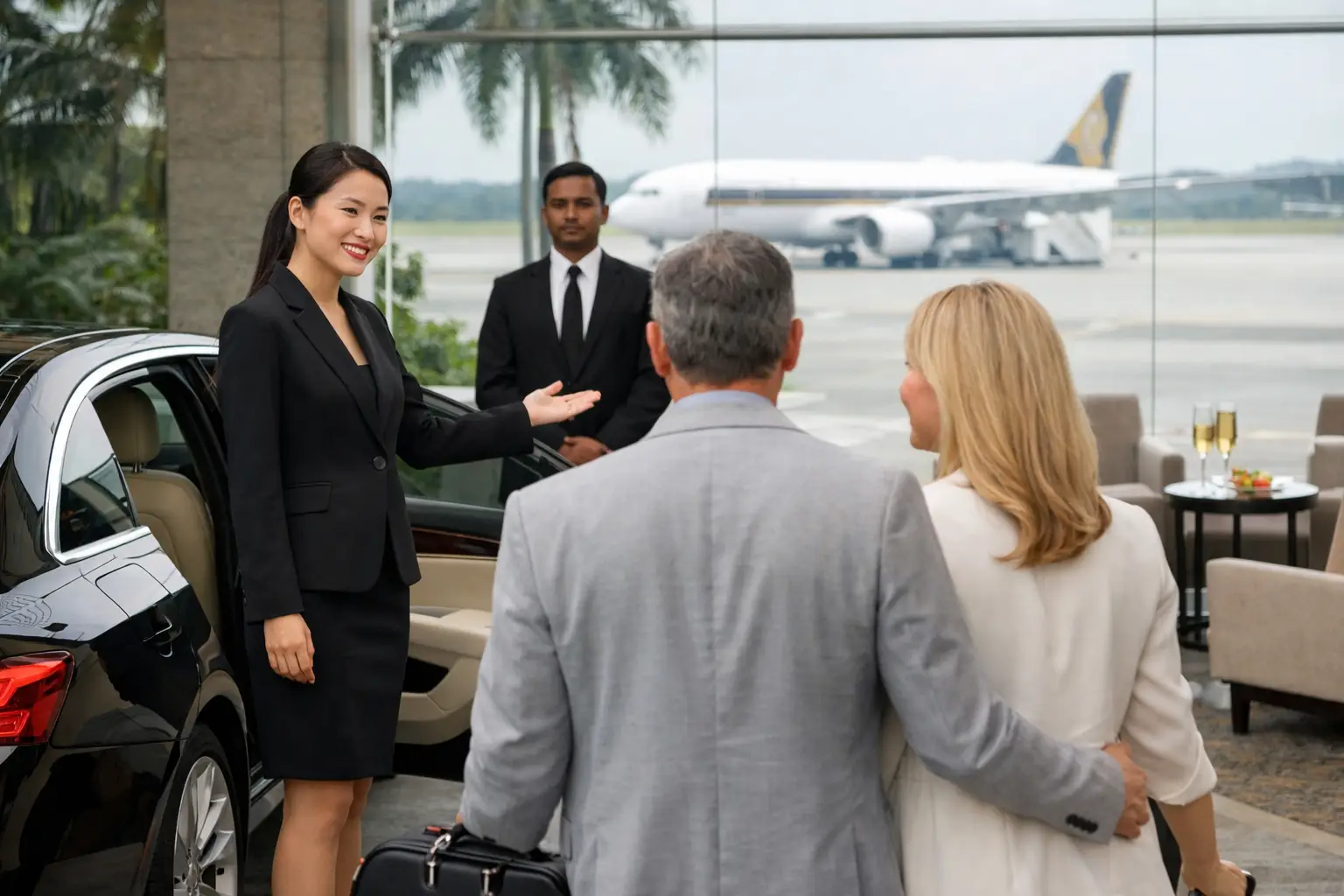
A late-evening arrival at Changi can look simple on an itinerary: land, clear formalities, collect luggage, leave the airport. For an executive, VIP guest, or arriving delegation, however, every handoff matters. A properly planned vip airport arrival service singapore is not simply a car waiting outside. It is a controlled arrival process that accounts for flight movement, terminal details, baggage time, passenger privacy, vehicle access, and the onward schedule.
For individual travelers, the objective is a calm, professional transfer to a hotel, residence, meeting, or private venue. For corporate travel managers and event teams, the objective is broader: ensure every guest is accounted for, routed correctly, and moved without creating a queue of unanswered calls at the terminal.
What a VIP airport arrival service should include
The core service begins before the aircraft lands. A chauffeur operation should receive the flight number, arrival date, passenger name, preferred contact method, destination, and vehicle requirement. Dispatch then monitors the flight and reviews the assignment so the chauffeur is positioned according to the actual arrival, rather than a timetable that may no longer be accurate.
At the airport, the arrival experience should be clear and discreet. Depending on the agreed arrangement, the chauffeur may meet the passenger in the public arrivals area with a name sign, coordinate directly by phone after landing, or follow a specific protocol provided by an executive assistant, security representative, or event organizer. The right choice depends on the guest profile. A visible name board can be practical for a first-time visitor, while a more discreet contact procedure may suit senior executives and public-facing guests.
The vehicle should be clean, licensed, commercially insured, and appropriate for both the number of passengers and their luggage. This sounds basic, but it is where many airport transfers fail. A luxury sedan may be ideal for one or two travelers with standard bags. It is not the right vehicle for two executives arriving with large cases, golf equipment, product samples, or multiple carry-ons. A premium MPV often provides the better arrival experience when space and comfort both matter.
VIP airport arrival service Singapore is more than a pickup
The difference between a standard ride and a VIP arrival service is operational ownership. A dependable provider does not leave the passenger to resolve delays, terminal confusion, or a vehicle mismatch alone. The service is planned around the variables most likely to change.
Flight tracking is central to that planning, but it is not the only factor. An early landing does not always mean an early exit. Immigration queues, checked baggage, customs procedures, and the distance from gate to arrivals can all affect the actual collection time. For this reason, experienced dispatch teams build reasonable flexibility into airport assignments and maintain communication between chauffeur, dispatcher, and booking contact where needed.
There is also a practical distinction between a chauffeur arrival transfer and formal airport VIP handling. Some travelers use the term “VIP airport service” to mean fast-track immigration, porter assistance, lounge access, or escorted airside services. These services may be arranged through separate airport or aviation providers and are subject to their own availability and procedures. A ground transportation provider should state clearly what is included in the chauffeur booking and what requires a separate arrangement. Clear scope protects the guest experience.
Choosing the right vehicle for the arrival
Vehicle selection should begin with the passenger profile, not the lowest available rate. For a single executive traveling light, an executive or luxury sedan provides a composed, private transfer. For families, senior leaders traveling with assistants, or guests with substantial luggage, a premium MPV is often the more sensible choice.
For delegations and event arrivals, fleet planning requires more discipline. A minibus may suit a small team arriving on the same flight, while a mini coach or full-size coach may be needed for conference participants, incentive groups, or staff movements. The vehicle decision should also reflect the destination. A group traveling to one hotel can move efficiently in a larger vehicle. Guests traveling to several hotels or meeting locations may need separate routed vehicles, even when they arrive together.
A corporate travel coordinator should provide passenger counts, luggage estimates, flight details, destination list, and special requirements as early as possible. This enables the transport provider to match capacity correctly and avoid last-minute substitutions. For larger programs, a written movement plan is preferable to a simple list of flight numbers. It creates a single operational reference for dispatch, chauffeurs, and the on-site coordinator.
Arrival planning for executives, families, and delegations
An executive airport arrival usually requires discretion and time awareness. The chauffeur should know whether the guest is traveling to a hotel, a board meeting, a private residence, or directly to an event venue. A guest arriving for a 9:00 a.m. meeting may need a route that prioritizes predictable travel time over a sightseeing-oriented city drive. If there is a schedule change, the booking contact needs a direct way to communicate it.
Family arrivals need different attention. Child seats, stroller capacity, extra luggage, and a comfortable boarding process should be discussed at booking. These requirements are straightforward when shared in advance and difficult to solve properly at the curb.
Delegations introduce another layer: accountability. Event organizers need to know who has arrived, which vehicle they entered, and whether they reached the hotel or venue. This does not mean treating every guest like a logistics item. It means using a practical arrival manifest, assigned vehicle plan, and a designated contact who can make decisions if flights split, passengers miss connections, or luggage delays separate one traveler from the group.
For complex MICE programs, airport operations should be coordinated with the entire ground plan. That may include hotel shuttle windows, venue loading restrictions, coach staging, VIP protocol, and return transfers. Limo Z supports this type of program through dispatch-led fleet coordination, from individual executive arrivals to multi-vehicle group movements.
Details that prevent avoidable airport delays
Most airport transfer problems are preventable. They usually result from incomplete booking information, not from the drive itself. Before confirming a VIP transfer, verify the exact flight number, not only the scheduled landing time. Confirm the airline, arrival date, passenger mobile number, and terminal information where available. International itineraries can be especially vulnerable to date errors when flights depart late at night or cross time zones.
The destination should be specific. “Marina Bay hotel” is not always enough for dispatch purposes, particularly when several properties have similar names or when the passenger is attending a function within a large venue. Include hotel name, address, event entrance, or building tower when relevant.
For high-profile guests, establish the meet-and-greet method in advance. Do not assume that the passenger wants their full name displayed publicly. An assistant may request an initials-only sign, a company name, a direct call upon landing, or collection from a designated meeting point. These small instructions are part of professional executive travel management.
It also helps to designate one decision-maker for changes. When an executive assistant, event manager, traveler, and security contact all send separate instructions, dispatch can lose valuable time reconciling them. A clear lead contact keeps adjustments controlled.
When to book and when to request a custom plan
A single airport transfer with a clear itinerary can usually be booked as a fixed-rate service when vehicle type, passenger count, and destination are known. This works well for business travelers, families, and executive visitors with straightforward requirements.
A custom quotation is the better approach when the movement involves multiple flights, several hotels, a large party, different arrival windows, meet-and-greet staff, or coach coordination. It is also advisable when transport is only one component of a broader event program. The value is not merely in reserving vehicles. It is in assigning the right fleet, building route logic, allowing for contingencies, and giving the organizer a dependable operating structure.
Price should be evaluated in that context. The least expensive airport car may be sufficient for a flexible, low-stakes trip. For a board member arriving before a major presentation, a client being hosted for the first time, or a delegation moving into a tightly scheduled conference, reliability has a measurable business value.
A well-run airport arrival feels uneventful to the passenger because the work happened before they reached the curb. Provide complete information, select the vehicle for real luggage and passenger needs, and agree on a contact protocol early. That preparation lets the guest step out of Changi focused on what they came to Singapore to do.