
Business Park Shuttle Guide for Singapore Teams
22 October 2026
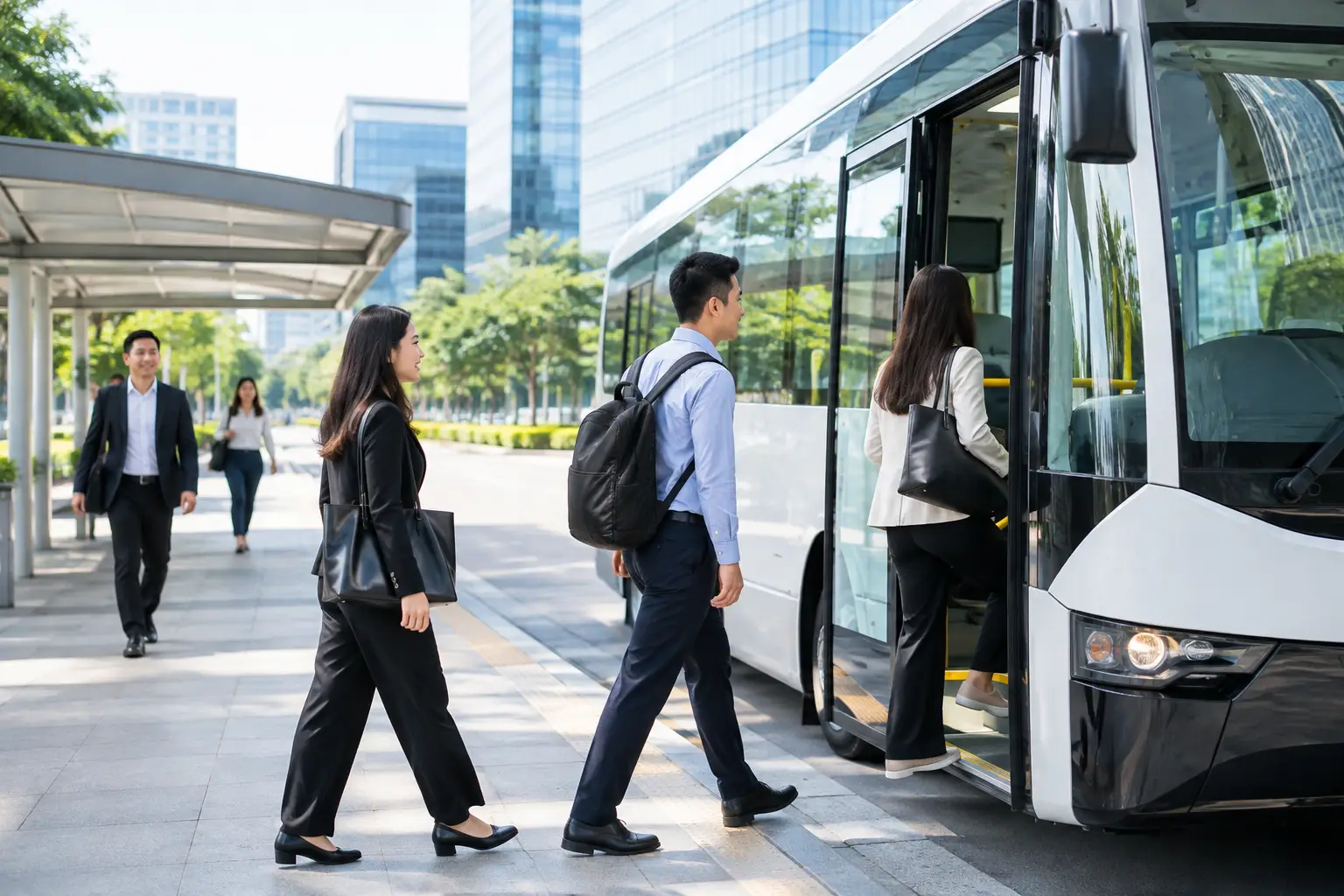
A late first shuttle can affect far more than a few arrival times. At a business park, it can delay shift handovers, create missed client meetings, and leave employees waiting at an interchange with no clear information. This business park shuttle guide is designed for HR, workplace, and operations teams that need employee transport to run on schedule, with clear accountability behind it.
What a Business Park Shuttle Must Accomplish
A business park shuttle is not simply a bus moving people between two points. It is a managed commuter service connecting employees, visitors, and occasionally contractors from transport hubs, nearby neighborhoods, or satellite offices to a workplace campus.
The strongest programs balance three priorities: dependable arrival times, appropriate passenger capacity, and a route that people will actually use. Those priorities can conflict. A route with many pickup points may be convenient for more employees, but it also increases travel time and exposes the schedule to more traffic variables. A direct service is easier to control, yet may leave seats underused if the pickup location is poorly chosen.
For most Singapore business parks, the practical objective is straightforward: deliver passengers before their required start time, provide a predictable return journey, and make service disruptions visible early enough for the operations team to respond.
Start With Demand, Not Vehicle Size
The first question should not be, “How many buses do we need?” It should be, “Who needs to travel, when, and from where?” A realistic demand profile prevents both under-provisioned peak services and expensive vehicles operating with empty seats.
Gather at least two to four weeks of attendance data where possible. Separate regular office staff from shift personnel, visitors, and employees whose working patterns change by day. Then identify the major origin points: MRT stations, residential clusters, other offices, park-and-ride locations, or event venues.
Peak demand usually deserves the greatest attention. A 9:00 a.m. office start may require the largest inbound wave between 8:00 and 8:45 a.m., while a production or service operation may need several smaller but time-critical shift changes. Return demand can be less concentrated, especially where flexible working hours apply. In that situation, one large outbound departure may look efficient on paper but leave employees waiting too long after work.
Fixed routes and flexible capacity
A fixed route with published departure times suits stable workforces and established business parks. It gives employees confidence, simplifies dispatch planning, and makes service performance easier to measure. It is generally the right choice for daily commuting.
Flexible capacity works better during onboarding periods, large meetings, seasonal workforce changes, or temporary office relocations. Rather than permanently adding a vehicle, an operator can schedule a supplementary run for known peak days. This approach controls cost while protecting punctuality when demand rises.
Build Routes Around Real Travel Conditions
A route should be designed from actual journey conditions, not map distance alone. Morning congestion, school zones, loading areas, security gates, and competing pickup activity can all affect a shuttle’s arrival time. A route that takes 18 minutes in light traffic may require 30 minutes during the morning peak.
Allow time for passengers to board, not just for the vehicle to drive. For a busy station pickup, dwell time can increase quickly when passengers are carrying laptops, umbrellas, or personal items. If multiple companies use the same pickup zone, the vehicle may also need contingency time for curb access.
A well-structured route generally has one defined primary pickup point and, where demand justifies it, one or two secondary stops. More stops are not automatically better. Each additional stop introduces another chance for traffic delay, missed passengers, and confusion about timing.
For high-volume sites, it may be better to operate two direct services from different transport hubs than one long looping route. The cost comparison should include more than vehicle hours. Consider employee wait time, likely adoption, punctuality risk, and the operational impact of late arrivals.
Select the Fleet for Capacity and Service Level
Fleet selection should reflect passenger volume, journey length, and the role the shuttle plays in the employee experience. An executive sedan or premium MPV can support senior leadership transfers, VIP guests, or a small team working late. Daily commuter movement normally calls for larger vehicles.
A minibus can be suitable for smaller teams or lower-demand inter-office routes. Mini coaches provide more capacity and passenger comfort for medium-sized groups, while full-size coaches are appropriate for major shift changes, large campuses, and consolidated hub services. The right vehicle is the one that handles expected load comfortably without creating excessive unused capacity.
Passenger comfort matters, but it should be evaluated in context. A short 10-minute shuttle may prioritize quick boarding and reliable frequency. A 40-minute cross-island commute may justify a higher-specification coach, better luggage accommodation, and more space between seats. Air conditioning, vehicle cleanliness, safe access, and professional driver presentation remain baseline requirements in either case.
Dispatch Control Is the Difference Between a Route and a Service
A schedule alone does not deliver reliable transport. Dispatch control does. Every business park shuttle program should have a clear operating plan covering vehicle assignment, driver reporting times, route instructions, escalation contacts, and backup procedures.
Vehicles should arrive ahead of the scheduled first pickup, particularly for morning peak services. Early arrival gives the driver time to assess the pickup area, manage boarding safely, and avoid beginning the route already behind schedule. It also creates room to respond if the assigned vehicle encounters an issue before service begins.
For routes influenced by airport traffic, city events, construction, or severe weather, the dispatcher should be able to adjust departure timing or deploy a replacement vehicle promptly. The goal is not to promise that disruptions will never occur. It is to have a controlled response when they do.
Communication should be equally deliberate. Employees need one clear source for routine schedule information and service advisories. The corporate transport lead needs a direct operations contact for urgent issues, passenger incidents, route changes, and capacity concerns. When a service is delayed, a vague update can create more frustration than a concise message stating the expected arrival time and next action.
Set Service Standards Before Launch
A shuttle provider should be assessed on more than its quoted rate. The commercial proposal should define operating hours, route assumptions, vehicle type, passenger capacity, waiting-time rules, and what happens if demand exceeds the agreed plan.
It should also address licensed and insured vehicles, driver qualifications, maintenance practices, and operational oversight. For corporate programs, ask how vehicle substitutions are handled, who monitors daily operations, and whether service reports can be provided. A premium transport partner should be able to explain these controls plainly, without relying on broad promises.
For larger programs, establish measurable standards from the beginning. These may include on-time departure performance, early-arrival expectations, passenger incident response, vehicle presentation, and a process for monthly route review. The exact targets depend on the site and operating conditions, but consistency is easier to manage when both parties define what good service means.
Plan for Exceptions, Not Just Normal Days
The normal weekday schedule is only one part of a business park shuttle operation. Board meetings, town halls, night shifts, rain disruptions, employee events, and visiting delegations can change passenger movement quickly.
A scalable transport plan identifies these exceptions in advance. A town hall may require extra coach capacity after the event. An evening function may need staggered returns to several locations. A delegation may need separate discreet executive transfers rather than joining the employee shuttle.
This is where a coordinated fleet becomes valuable. The same transport program may need a full-size coach for staff movement, a minibus for a smaller overflow group, and a premium MPV for executive travel. Managing those movements under one dispatch structure reduces conflicting instructions and provides the corporate team with a clearer view of the day’s transport activity.
Review the Program After Employees Use It
Launch data often reveals what planning assumptions missed. Review passenger counts by run, no-show patterns, recurring traffic delays, and employee feedback during the first month. A lightly used stop may be removed, while a consistently full service may require an added departure or a larger vehicle.
Do not treat employee feedback as the only measure. People may ask for more stops or later departures because they are personally convenient, even when those changes reduce reliability for the wider group. Compare feedback with ridership data and actual journey performance before altering the route.
The best shuttle program is usually not the one with the most stops or the most expensive vehicles. It is the one employees can depend on without having to think about it. When routes, fleet capacity, dispatch oversight, and exception planning are aligned, the daily commute becomes one less operational variable for the business to manage.